How to use a camera strap
Updated on
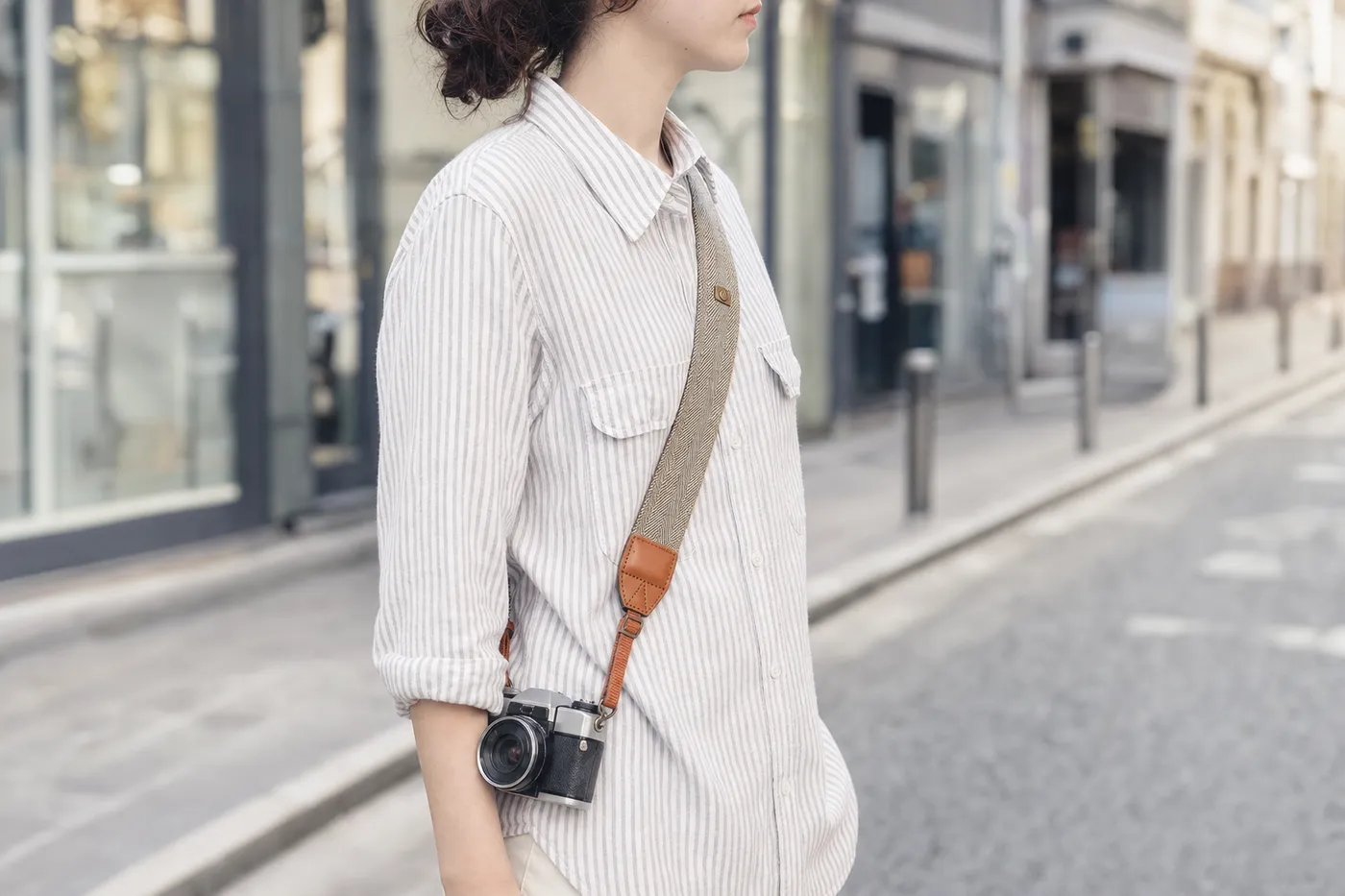
Fitting a strap takes four minutes and there are guides for it everywhere. Using one takes a day, and almost nobody writes that part down. The result is a lot of photographers carrying a perfectly good strap in a way that fights them: the camera swinging into door frames, a loose tail flapping at the elbow, a body that arrives at the eye half a second late every time.
What follows is the part after the knot. It assumes the strap is already fitted and already set to a length that suits you, and deals with the next eight hours.
The first two minutes of a shooting day
Put a hand on each attachment point and pull. Not a polite tug, a real pull, with the camera hanging. Hardware that is going to let go does it in the first three seconds rather than on hour six. The fitting sequence for both of our systems is in how to attach a camera strap.
Then decide the carry position before you walk out, not at the first interesting corner. Our camera neck strap page covers setting the drop so the body lands where you shoot, and the shoulder and crossbody page works through what changes when the strap goes across you. Pick one and commit, because a length reset in the street is always a compromise.
Last, look at the strap itself: flat, no half twist, both ends facing the same way. A twisted strap turns the camera to face outward, which puts the front element toward every wall you pass.
digital cameras shipped worldwide in 2025, the highest annual total since the pandemic
— CIPA shipment data, via DPReview, 2026
Most of those bodies are new to the person carrying them, and people learn from whatever came in the box.
Wrapping the slack around your hand
This is the technique I would teach first, and it works with the two point strap already on your camera. You are taking the slack that was hanging between the lugs and your neck and putting it somewhere useful.
Three things happen at once. The camera stops swinging, because the loose strap is now under tension. Your grip gets steadier, because that tension pulls the body into your palm instead of leaving it balanced on your fingers, which is worth real fractions of a stop at slow speeds. And if your fingers open, the camera drops into the loop instead of onto the pavement.
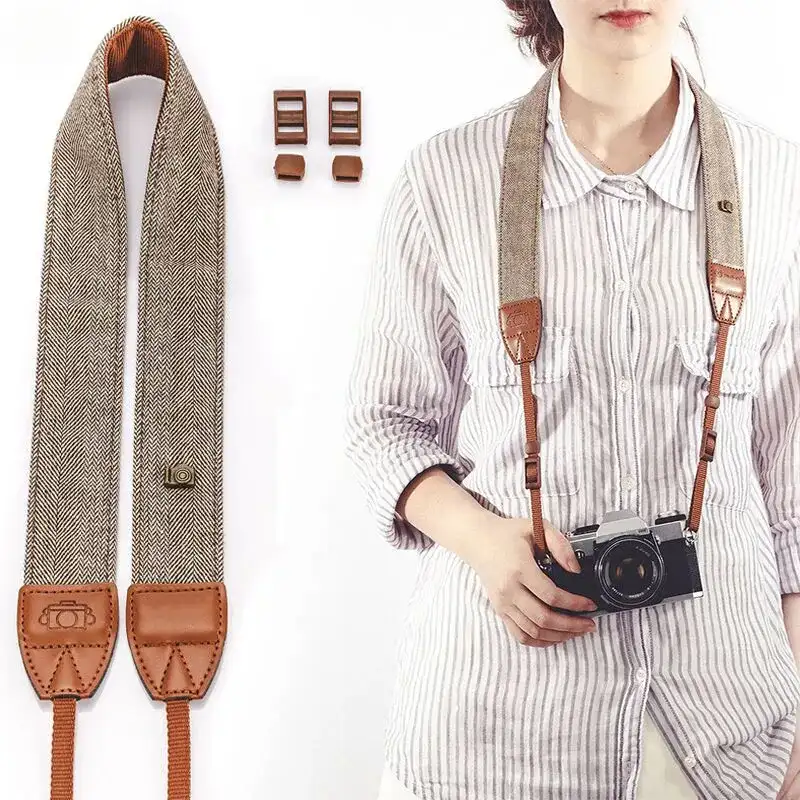
The wide band is the more pleasant one to wrap, because it lies flat across the back of the hand and spreads the pressure, which is a quiet reason people who shoot handheld all day gravitate to our cotton and leather strap. A braided cord does the same job in a smaller package. Either way, unwrap deliberately: turn the wrist back the way it came and let the loop fall.
Walking with the camera on the strap
An unheld camera on a strap behaves like a pendulum, and pendulums build. On flat ground it is nothing. Going down stairs, stepping off a curb or turning quickly, it picks up enough amplitude to hit a hip bone, a railing or the person next to you. A hand resting on it kills the oscillation before it starts.
In a crowd, shorten the free strap rather than the fitted length: gather the slack in your fist so the camera sits high and tight against your chest, walk through, then release.
written buyer reviews that raise comfort on the neck or shoulder without being asked
— Camstrand count across 119 buyer reviews, 2026
Comfort comes up on its own in about one review in eight, and the pattern in those verbatims is not padding. It is a camera that stays where it was put, because your body stops making small corrections it never registers consciously.
What dangles, and what it catches
The loose tail is the easiest to fix. On a wide band, the end that comes back through the slider belongs tucked under the keeper. A free tail brushes your forearm every step, and it catches in a bag zip, which is how tails become frayed tails.
A lens cap on a string causes the most actual trouble. It swings on a longer radius than anything else on the camera, and it lands in front of the lens exactly when you raise the body to your eye. Tuck it under the strap on your chest instead.
The strap in the frame shows up later, on the computer. At wide focal lengths, especially with a hood fitted, a strap that has drifted forward clips the bottom corner as a soft dark band. Pull both sides back over your shoulders before a wide shot.
Last, the strap over the eyecup. When you lift the camera, one side wants to lie across the viewfinder; sweep it back with your thumb as the body comes up. If you take the strap off entirely for tripod work, the ring system on our braided range makes that a two second job, explained in the quick release guide.
Sitting down, crouching and getting into a car
Sitting down catches everyone. You bend, the camera swings forward and down, and it either lands on the table or slaps back into your sternum. The fix is one movement: hand on the body, bring it to your stomach, then sit. Once down, keep it in your lap or let it hang to one side, never between your knees.
Crouching is gentler but has a longer reach: going down on one knee drops the camera almost to the ground on a full length strap. Shorten with your fist as you go down, the same gather you use in a crowd.
Cars are the expensive one. Getting in with a camera on your chest means the body meets the door frame or the steering column at hip height. Take the strap off over your head first, or swing the camera to your back for the two seconds it takes to sit.
photography insurance claims that came from accidental damage rather than theft
— Towergate Insurance records, via Digital Camera World, 2014
Claim files put accidental damage far ahead of theft, and that matches what I see in the field. Cameras are knocked, dropped from short heights and swung into hard edges by their owners, doing ordinary things like sitting down.
Carrying a long lens on a strap
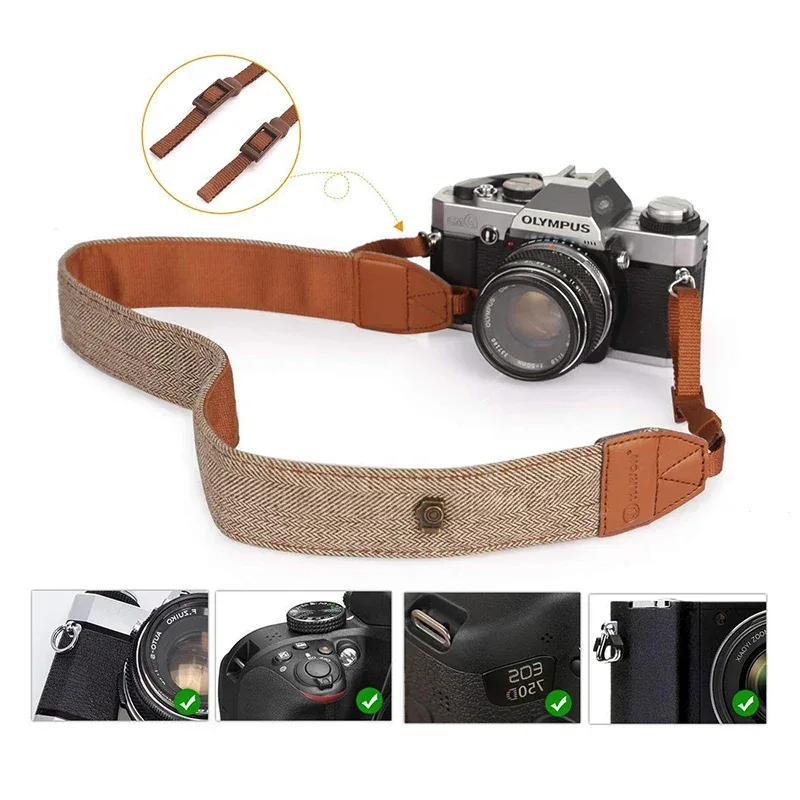
The geometry is the whole story. A strap anchors at the two lugs on the top corners of the body. With a small lens the center of mass sits close to that line and the camera hangs flat. Fit something long and the mass moves forward past the front of the body, so the rig rotates until the lens points at the floor and stays there, pulling on the mount for as long as you walk.
Two habits handle it. The supporting hand goes under the barrel, elbow tucked in, so the lens rides against your ribs. And carry the rig shorter than a bare body, so it sits high and close rather than swinging on a long arc.
If your lens has its own tripod collar, that is where a support hand naturally falls, and setting the rig down on the collar foot rather than the barrel keeps weight off the mount. Which lugs your body has is worked through in the compatibility guide.
Cold weather, and where the strap goes
Winter tests carry habits, partly because there is more fabric involved and partly because more cameras are new in December than in any other month. Under a coat, the camera swings inside your clothing and every picture starts with unzipping. Between locations that is a fine trade. While you are working it is not.
Worn over the coat, a strap slides on smooth outerwear more than it does on a shirt. This is where a wide band earns its keep, because the extra face area grips a slippery shell instead of walking off the shoulder.
Gloves change the hand wrap. Thick gloves make a wide band harder to loop cleanly and a thin cord easier, which is one reason our braided rope strap gets picked for cold months, and a cord disappears under a collar instead of bunching under a scarf.
Short answers
Should the camera face in or out when it hangs?
How do I stop the strap from sliding off my shoulder?
Do I need to take the strap off to put the camera in a bag?
These are habits, not hardware. The full range of seventeen models is below, and more guides sit on the blog index.