Camera neck strap: what actually starts to hurt after three hours
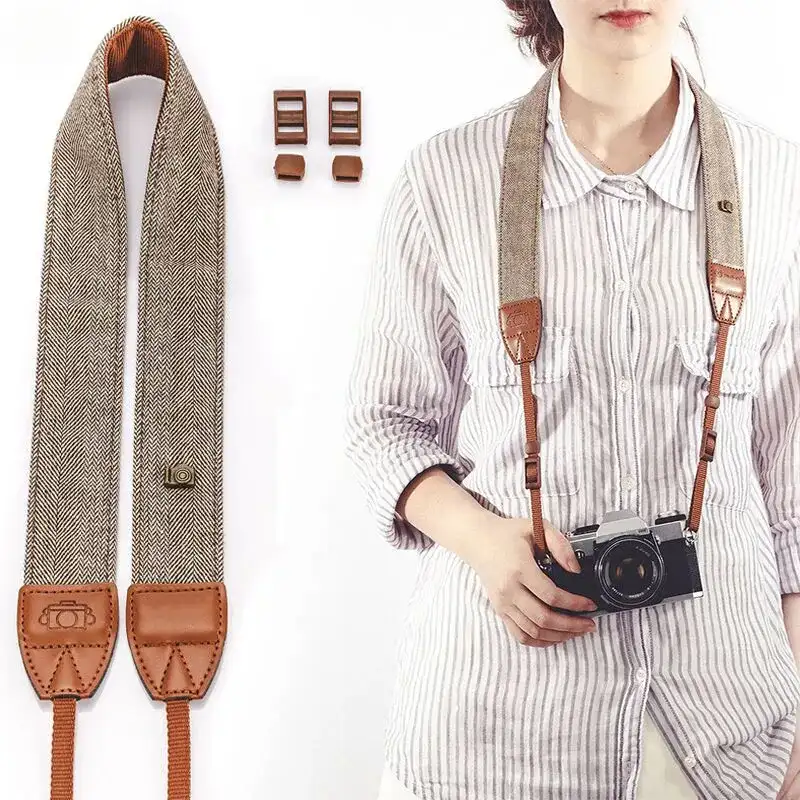
How much weight really hangs from a neck strap
That figure matters because your neck is already loaded before the camera arrives. An adult head sits at roughly ten to twelve pounds when it is balanced over the spine, and the load the cervical spine carries climbs steeply the moment the head tips forward. A camera on a strap encourages exactly that forward tilt, because you glance down at the screen, then down at your feet, then down at the screen again. The strap is not doing the damage. The hours of small forward tilts are.
Weight of a Canon EOS R5 Mark II body with card and battery (746 g)
Weight of a Canon RF 24-70mm f/2.8L IS USM, a common walk-around zoom (900 g)
Force on the cervical spine at 15 degrees of forward head tilt, against 10 to 12 lb upright
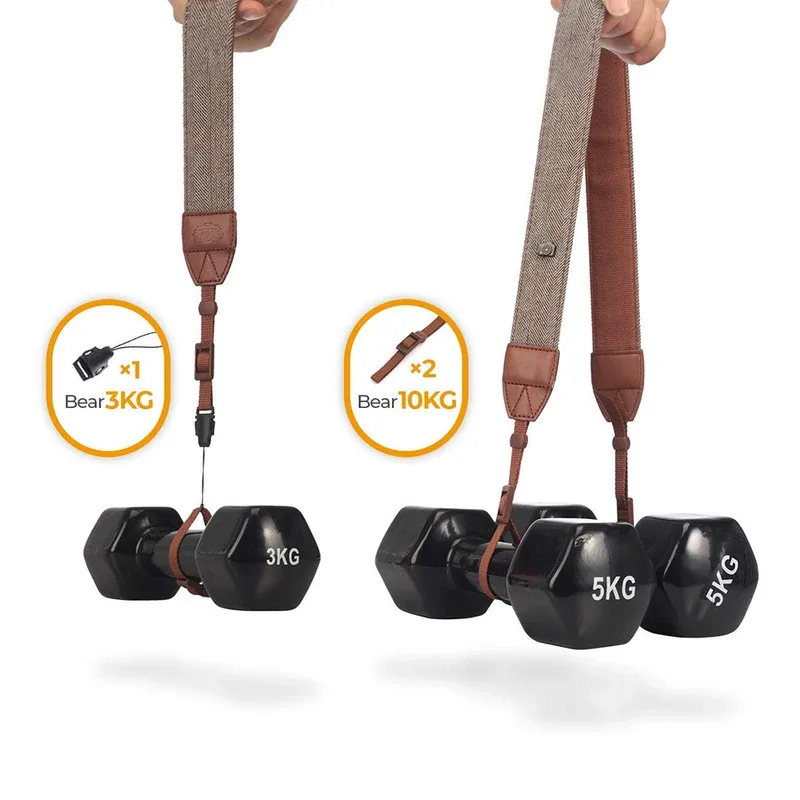
Our cotton and leather range is the only one with a published load figure, because it is the only one with a published weighing. Hung from a single attachment cord it held 6.6 lb (3 kg), and hung from both leather tabs it held 22 lb (10 kg). Those numbers belong to the woven band alone.
Why band width changes what your neck feels
This is also where honesty is worth more than a sales line. A round braided cord is the more discreet object. It disappears against a jacket, it does not flap, it rolls into a coat pocket, and it looks right on a small rangefinder-style body. But it presents a narrow contact strip to your skin, so the same camera pushes harder into a smaller area. On a light body with a pancake lens you will never think about it. On a heavy body with a fast zoom, on a bare neck in July, you will.
The woven band trades that discretion for surface. It is the strap you want when the camera is heavy or the day is long, and it is the one people describe as comfortable in the reviews below. It is also bulkier: it does not vanish under a collar and it does not coil small. Neither range is the better product. They solve different halves of the same problem.
| What you notice | Cotton and leather band | Braided rope cord |
|---|---|---|
| Contact with the neck | Wide woven face, load spread across it | Narrow round section, load concentrated |
| Over bare skin in summer | Softer, but a warmer strip of fabric | Cooler, though you feel the cord line |
| Under a collar or a jacket | Visible, sits proud of the fabric | Nearly invisible, follows the collar |
| Attachment | Webbing cord through the lug, locked under a leather tab | Split rings plus a quick-release ring, no tools |
| Packing it away | Folds, keeps its shape | Coils into a pocket |
| Published load figure | 6.6 lb (3 kg) on one cord, 22 lb (10 kg) on both tabs | — |
What buyers actually raise about wearing it
Our count across the 119 written buyer reviews (July 2026). The rows below are the ones that touch on carrying the camera. Overall the two ranges sit at 4.8 out of 5 across 259 ratings.
| Theme raised unprompted | Reviews | Share |
|---|---|---|
| Build quality and strength | 67 | 56% |
| Comfort at the neck or shoulder | 14 | 12% |
| Easy to fit and adjust | 10 | 8% |
| Matches the description | 7 | 6% |
Comfort at 12% is not a landslide, and we would rather show you the real number than round it into a promise. Verified reviews.
Excellent product, the strap is firm and slightly padded, making it comfortable to wear around the neck. — Verified buyer, cotton and leather range
Resistant. It has a good length and is slightly wider than the original Sony one (but less hard or dense, without losing firmness though). Very comfortable. — Verified buyer, cotton and leather range
Setting the length so the camera sits where you shoot
On the cotton band, length lives in the webbing tails. You pull the tail through the slider, set the drop you want, then tuck the loose end back so it does not flap. On the braided cord, the cord runs through a ring and locks off, so you set the loop length once and forget it. Both keep their setting; neither creeps back over a day of shooting.
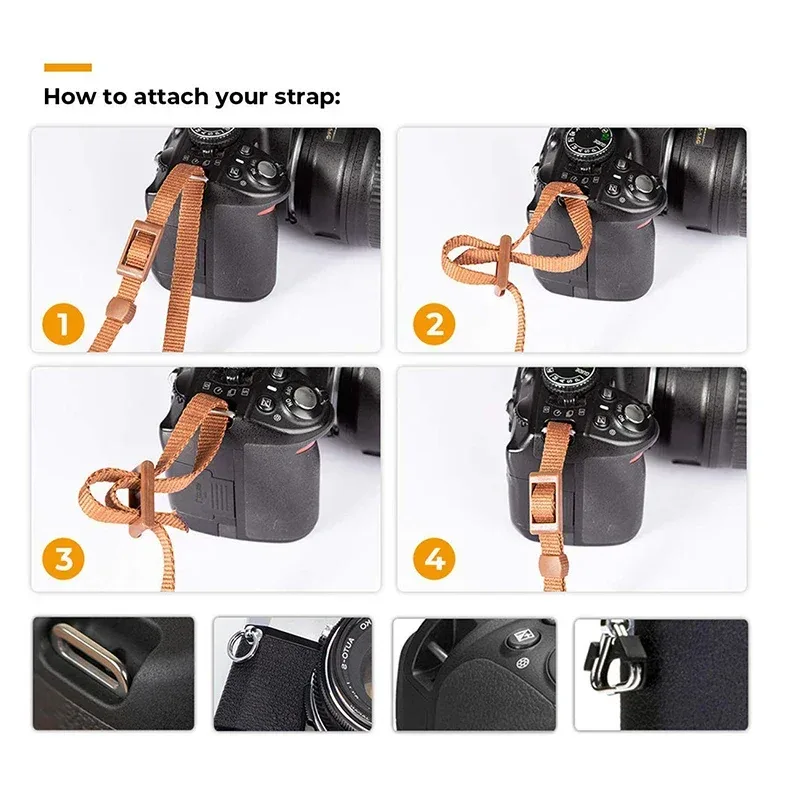
Attachment is the part people get wrong on the first try, and it is the part that matters most, because it is the only thing between your camera and the sidewalk. The four-step sequence for the cotton range is on the fitting card and in our guide to attaching a camera strap. If you are moving a strap between bodies every week, the ring and quick-release system on the braided range is the faster answer, and we explain it on the quick-release camera strap page.
When a neck strap is the wrong tool
It is also the wrong tool in a crowd. A camera hanging in front of your chest catches on bag straps, turnstiles and other people's elbows, and it swings when you crouch. Cross-body carry pulls it back to your hip and out of the way, which is the argument we make in full on the camera shoulder strap page. And if you are weighing a neck strap against a wrist strap or a full harness, we measured the three side by side in neck versus wrist versus harness, on where the load sits, whether your hands stay free and how fast the camera reaches your eye.
One more honest limit. Nothing about a strap protects a camera from a lug that was never tightened or a split ring that was forced open. Check the attachment points every few weeks. It takes ten seconds and it is the cheapest insurance in photography. This page was written by Ivan Petrić, who runs the Camstrand test bench; the method is on how we test.
Camera neck strap questions
Is a camera neck strap bad for your neck?
Worn badly, it can be. The strap itself is not the problem; the posture is. Trouble starts when the camera hangs so low that you lean forward to lift it, or when a narrow cord digs into one spot for hours. Set the length so the body rests at your sternum, keep your head level between shots, and swap to cross-body carry when the day runs long.
What is the difference between a neck strap and a shoulder strap?
Usually nothing but length and how you wear it. Every strap we sell is long enough for both. Around the neck, the load splits across both shoulders and the camera sits centered on your chest. Across the body, the same strap puts the load on one shoulder and the camera at your hip, where it swings less and stays out of the way.
Does a wide strap really feel lighter than a thin cord?
It does not weigh less, it just presses less. The same camera spread over a wide woven band pushes into more skin than the same camera on a round cord, so the pressure at any one point is lower. Nothing about that is magic. It is why a backpack has wide straps and a plastic grocery bag handle hurts.
How long should a camera neck strap be?
Long enough that the camera sits at the bottom of your ribcage when you stand relaxed, and short enough that it does not swing into a table when you bend. Both of our ranges adjust. On the cotton band you slide the webbing tails; on the braided cord you move the cord through its ring before you lock it off.
Will it fit my camera?
Both ranges attach through the standard strap lugs found on DSLR and mirrorless bodies, and they are listed for Sony, Nikon, Canon and Fujifilm cameras. The cotton range threads through the lug on a webbing cord and locks under a leather tab. The braided range clips on with split rings and a quick-release ring, so it comes off without tools.
Where to go next
- All seventeen camera strap models — the full product page, with both ranges side by side.
- Leather camera strap — where the leather actually is on the cotton range, and where it is not.
- Rope camera strap — the fifteen braided models and the ring system.
- Camera shoulder strap — cross-body carry, and how a fixed two point strap differs from a sliding sling.
- Canon, Nikon, Sony and Fujifilm fit — which lugs take which attachment.
- How to choose a camera strap — the short version, without the marketing.
- Camera strap reviews — every written review we have, sorted by range.