Rope camera strap: fifteen braided cords and a ring system
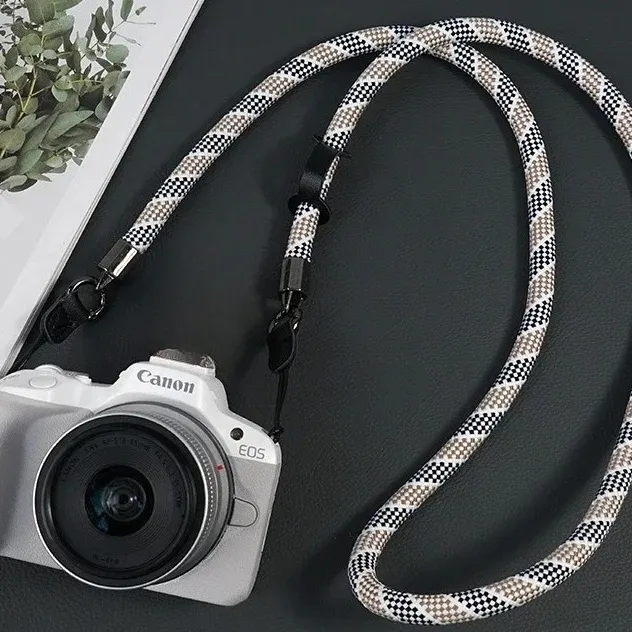
What the ring system actually does
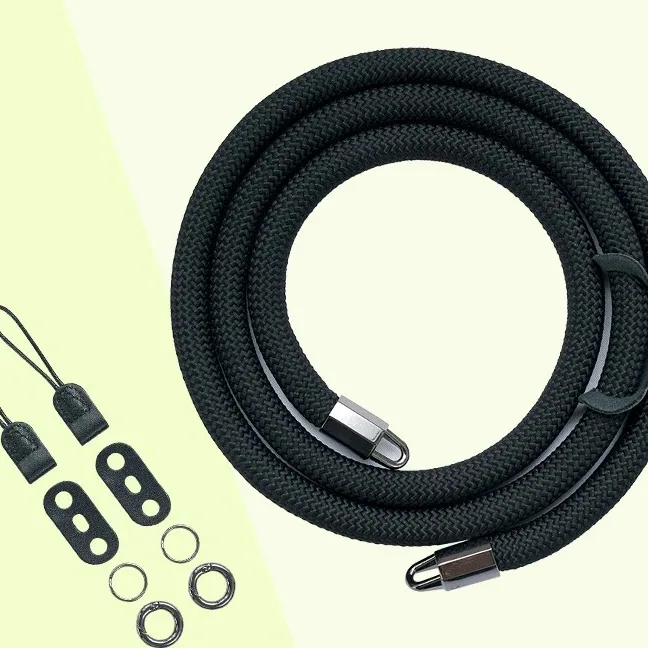
The kit that ships with every cord model covers the awkward bodies too. There are two looped attachment cords, thin enough to pass through an eyelet that would never take flat webbing, for small mirrorless and compact bodies. There are two flat perforated tabs for lugs that prefer something broader. And there are three split metal rings, so you can leave rings on more than one camera and move the single strap between them.
One honest note about split rings, because it is the failure people actually report. A split ring that has been forced open with a fingernail can end up slightly sprung, and a sprung ring is a ring that can walk off a lug. Open it with a ring tool or a coin, close it flat, and check that the gap has shut. One buyer in our review file wrote that a ring on their set would not open at all, which is the opposite problem and a much safer one to have.
Super quality, many options for attaching the strap to the camera. — Verified buyer, braided rope range
Solid or marl: the only real choice in the fifteen
The full range, split by braid. We list it because no product page we found separates the two families, and the choice between them is the one question buyers actually ask.
| Braid | Models | What it does on camera |
|---|---|---|
| Solid, one color | Black, Navy, Gray, Red, Olive, Sky Blue, Pink, Camel | Reads as a single clean line. Black and Navy disappear against a dark body; Red and Sky Blue are deliberately loud. |
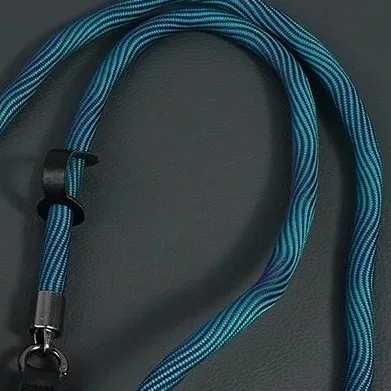
| Marl, two tones braided together | Black Marl, Blue Marl, Teal Marl, Purple Marl, Pink Marl, Orange Marl, Mint | Flecked texture. Hides dust and finger oil, and breaks up against a busy background instead of drawing a hard line. |
Fifteen cord models in total, plus the two cotton and leather models, for seventeen in the selector. Verified reviews.
What a rope strap is made of, and what we will not tell you
Our cotton and leather range does have measured figures, 6.6 lb (3 kg) on a single attachment cord and 22 lb (10 kg) on both leather tabs, because that range was put on a scale and the test photographed. No equivalent test exists for the cords. Plenty of listings will still quote you a number on a cord strap. Ask where it came from. If the answer is a generic figure for a rope diameter rather than a test of the finished strap with its fittings, it tells you nothing about the part that actually breaks, which is never the middle of the cord.
Nylon does bring two real properties worth knowing. It takes up far less moisture than cotton, so a cord worn on a bare neck in summer stays drier than a woven band. And a braided round section resists abrasion at the point where it rubs the camera body, which on a flat band is where you first see fuzz. Neither of those is a load claim. They are the reasons the cord is the better strap for hot weather and for straps that live in a bag.
The cameras a cord strap suits
Mirrorless cameras shipped worldwide in 2025, up from 5.6 million in 2024
DSLRs shipped in 2025, down from 997,608 the year before
There is a second shift underneath those numbers. Quick release is normally something you buy on top of a strap, as a separate set of connectors fitted afterwards. On our cord range the rings and the attachment pieces are in the box, because the strap was designed around them rather than retrofitted with them. Our guide to quick-release systems walks through how the different approaches attach.
Where a cord strap is the wrong choice
It is also the wrong choice if you want padding. There is none, by design. The cord is the same section from end to end, which is what makes it coil into a jacket pocket and what makes it press harder. The comparison in full, with the reasoning about contact area, is on the camera neck strap page, and the woven alternative is described part by part on the leather and cotton strap page.
Worn across the body rather than around the neck, a cord behaves better than most people expect, because the load moves off the neck entirely and onto one shoulder. That is covered on the camera shoulder strap page, which also sets a fixed two point strap against a sliding sling. If you are still weighing carrying styles, the side by side sits in neck versus wrist versus harness.
The length is appropriate and it looks sturdy. It's great because it comes with many accessories for different types of use. — Verified buyer, braided rope range
Fitting takes under a minute once the rings are on the body. If your camera has never had a strap on it, start with our attachment guide and check which lugs take which fitting before you force anything. This page was written by Ivan Petrić, who runs the Camstrand test bench; the method is on how we test, and every written review we hold is on the reviews page.
Rope and paracord camera strap questions
Is this a paracord camera strap?
It is a braided nylon cord, which is the same family of material people mean when they say paracord, but we make no mil-spec claim for it and we publish no breaking strength for it. If a listing quotes you a load rating on a cord strap, ask where the number was measured.
How does the quick release ring open?
The cord ends in a metal fitting that closes onto a split ring, and that ring is what stays on the camera. To take the strap off you open the ring fitting and lift the cord away; the camera keeps its rings and is ready for the next strap. It means a strap can move between two bodies in seconds without threading anything.
What comes in the box?
The cord itself plus the mounting kit you can see in every product photo: two looped attachment cords for bodies with small lugs, two flat perforated tabs, and three split metal rings. Between those pieces there is a way onto almost any DSLR or mirrorless body, including the compact ones with an eyelet too small for webbing.
What is the difference between the solid and the marl models?
Only the braid. A solid model is braided in one color throughout, so it reads as a single clean line. A marl is braided from two tones, which gives a flecked, ropey texture that hides scuffs and dust better than a flat color does. Construction, fittings and mounting kit are identical across all fifteen.
Will a thin cord dig into my neck?
It presses on a narrower strip of skin than a wide woven band does, so with a heavy body and a fast zoom on a bare neck you will feel it sooner. With a small mirrorless body, or worn over a jacket, most people never think about it. If you carry heavy gear all day, our cotton and leather band is the better call.
Where to go next
- All seventeen camera strap models — the cords and the woven band in one selector.
- Camera neck strap — why width changes what your neck feels.
- Leather camera strap — the woven alternative, and where its leather really is.
- Camera shoulder strap — cross-body carry with a cord.
- Quick-release camera straps — ring systems, anchors and what each one costs you.
- Canon, Nikon, Sony and Fujifilm fit — lug shapes and which fitting suits them.
- Camera strap reviews — the written reviews behind the quotes above.