Camera shoulder strap: the same strap, worn across the body
Sliding sling or fixed two point: what changes at the lug
What we sell attaches at the two strap lugs and stays put. Nothing rides along the webbing. To shoot, you lift the camera the way you would from any two-point strap, and the strap follows your shoulder instead of feeding through a hardware slider. That is a genuine functional difference, and here is how the two compare honestly.
| Sliding sling strap | Our two-point straps | |
|---|---|---|
| Attachment | Usually one point, screwed into the tripod socket | Two points, through the strap lugs |
| To shoot | Camera slides up the strap to your eye | You lift the camera, the strap stays where it is |
| Camera at rest | Hangs lens-down at the hip | Hangs across the body at the hip, lens inward |
| Tripod socket | Occupied unless you add a plate | Free, always |
| Moving parts | Slider, lock, swivel | Rings and fittings, nothing that travels |
A sliding sling puts the camera on a rail: it travels up the webbing to your eye, then back down to your hip. That single motion is the whole point of the design, and the table shows the two places it is paid for — a tripod socket you give up, and a slider, lock and swivel that move every time you shoot. A two-point strap worn across the body leaves the camera in the same place at rest, with nothing that travels and the socket free every time you need it. Our comparison of neck, wrist and harness carry lays out the same trade-offs carry by carry.
What actually changes when you move the strap across your body
The trade is that one shoulder now takes everything. That is why cross-body beats hanging a strap off a single shoulder without crossing it: the strap running diagonally across your torso is held in place by your body, so it neither slides off nor forces you to hitch that shoulder up to keep it there. When researchers compared the two on the same load, the difference in muscle activity was not subtle.
Upper trapezius activity carrying a bag on one shoulder, against 125% for the same load carried cross-body
That study used a bag at 10% of body weight, not a camera, and we are not going to stretch it into a health claim about a strap. Read it as what it is: evidence that the diagonal is a better line than the vertical one when a load has to sit on a shoulder. It is also why the same 20 people showed less difference between their left and right back muscles carrying cross-body.
Setting up crossbody carry with our two ranges
Our own setup notes for the two ranges, written from the way each one adjusts rather than from a generic instruction sheet. Both share the same rule: set the drop with the camera on, standing, not with the strap flat on a table.
| Step | Cotton and leather band | Braided rope cord |
|---|---|---|
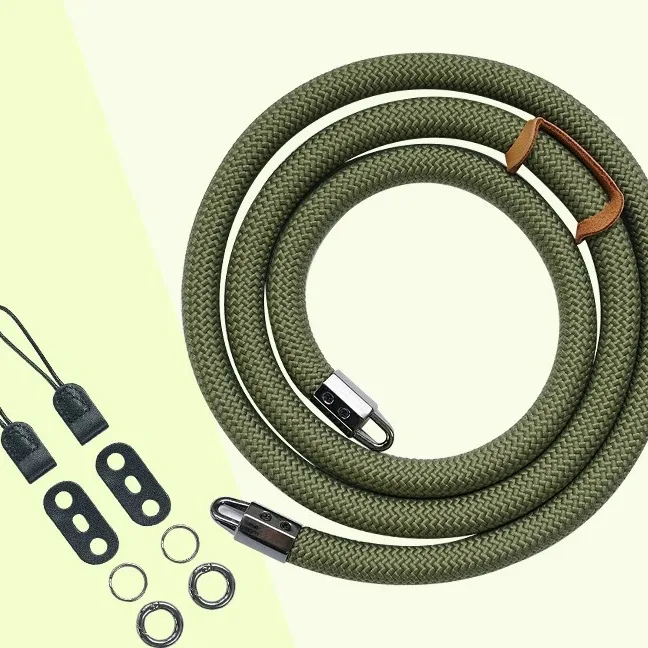
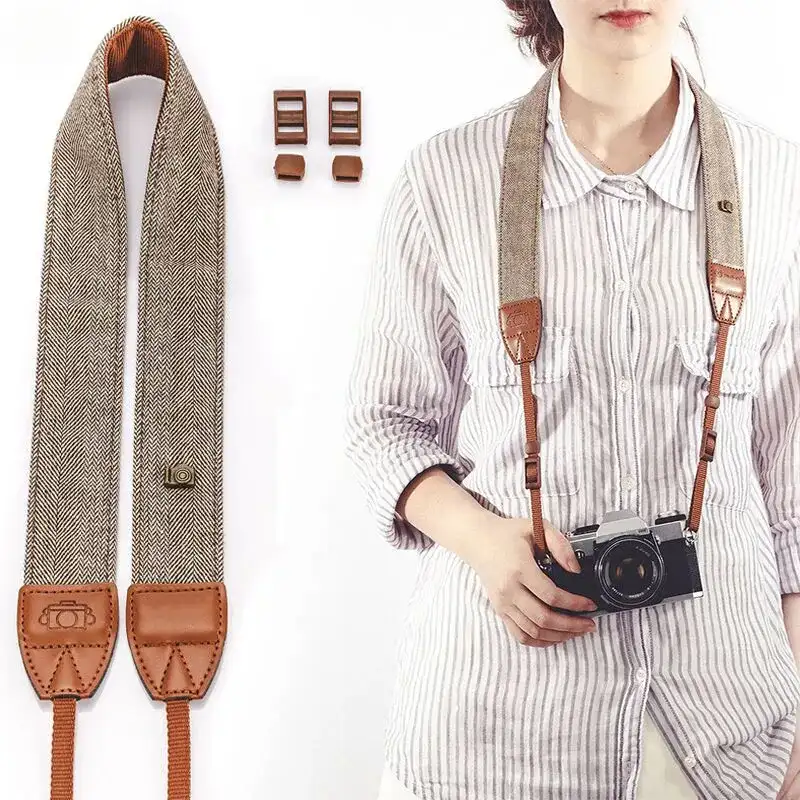
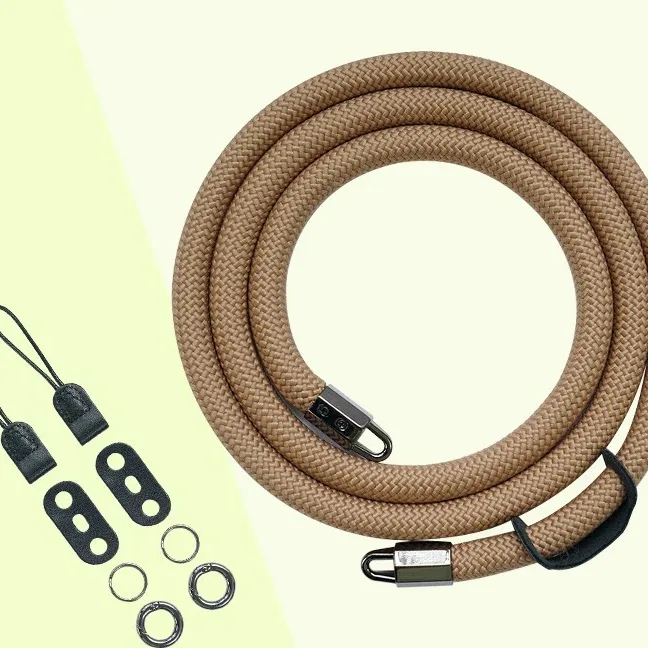
| Fit to the body | Webbing cord through the lug, folded and locked under the leather tab | Split ring on the lug, cord fitting clipped to the ring |
| Set the drop | Pull the webbing tails through the sliders on each side | Run the cord through its ring, then lock it off |
| Where it lands | Band sits flat and wide on the shoulder | Cord follows the collar, sits under a jacket |
| Taking it off the camera | Unthread the tabs | Unclip, rings stay on the body |
| Best case for it | Heavier body, longer day, load spread wide | Light body, hot weather, strap that packs small |
Fit and adjustment came up in 10 of the 119 written buyer reviews (July 2026), 8% of them, and nobody in that group described it as difficult. Verified reviews.
Reasonably comfortable and very ... vintage stylish looking camera neck or should strap. I like it a lot. Been using it for the last 3 weeks — Verified buyer, cotton and leather range
Two bodies, two straps, one shoulder each
This is the reason the two-strap pack exists in the selector at the top of this page, and the reason it lets you pick a different model for each strap. A dark cord on one body and the woven band on the other is not just decoration: it tells you which camera you are grabbing without looking. If you shoot that way, the braided range is worth reading about on the rope camera strap page, because moving one strap between bodies is what its ring system is for.
Two cameras also make the case for checking your attachment points more often, not less. Every extra strap is another pair of lugs, rings and tabs to inspect. Our attachment guide shows what a correctly closed fitting looks like on both ranges, and the quick-release guide covers what you gain and lose by making a strap easy to remove.
When to go back to the neck
There is nothing to buy to make that switch. Lift the strap over your head and it is a neck strap again, which is exactly what our camera neck strap page is about, including the part where a wide band and a round cord feel different against bare skin. If the deciding factor for you is the look on the camera rather than the carry, the leather and cotton page maps out what that range is actually made of, part by part.
This page was written by Ivan Petrić, who runs the Camstrand test bench and shoots on two bodies most weekends. Our method is on how we test, and every written review behind the counts on this page is on the reviews page. If your body has an unusual lug, check the compatibility guide before ordering, or read how to choose a camera strap if you are still weighing the options.
Shoulder, crossbody and sling questions
Do you sell a camera sling strap?
Not the kind most people mean. A sling strap in the strict sense has a connector that slides along the webbing, usually screwed into the tripod socket, so you drag the camera up the strap to your eye. Ours attach at the two strap lugs and are long enough to wear across the body, which covers most of the same ground with fewer parts, leaves the tripod socket free, and has no slider to seize.
Can the same strap be a neck strap and a shoulder strap?
Yes, and on both of our ranges it is the same object worn two ways. Around the neck, the load splits across both shoulders and the camera sits centered on your chest. Across the body, all of it lands on one shoulder and the camera drops to your hip, where it swings less and stops catching on things when you crouch.
Is crossbody carry better for your back than one shoulder?
Research on bag carrying points that way. Measured against carrying the same load on one shoulder, cross-body carrying produced much lower upper trapezius activity and less asymmetry through the back muscles. It is not a medical claim about our strap. It is a reason to run the strap across your body rather than hanging it off one side.
Which of your models works best across the body?
Both ranges do. The cotton and leather band spreads the load over a wider face, which matters more in cross-body carry than in neck carry because everything is on one shoulder. The braided cords are lighter and vanish under a jacket, which is why people who walk cities all day tend to pick one.
Will the camera swing forward when I bend over?
Less than on a neck strap, and that is the main practical win. Worn across the body the camera sits behind your forearm at hip height, so bending tips it into your side rather than out into space. Shorten the drop a little if you are climbing or leaning over railings, and keep a hand on the body.
Where to go next
- All seventeen camera strap models — both ranges, one selector, one price.
- Camera neck strap — the same straps worn the other way.
- Rope camera strap — the ring system that makes one strap serve two bodies.
- Leather camera strap — the woven band, and where the leather really sits.
- Neck, wrist or harness — a comparison of gear we do not all sell.
- Quick-release camera straps — what fast removal costs you.
- Camera strap reviews — the written reviews, sorted by range.