Camera strap for hiking: what the trail asks of a strap
Updated on
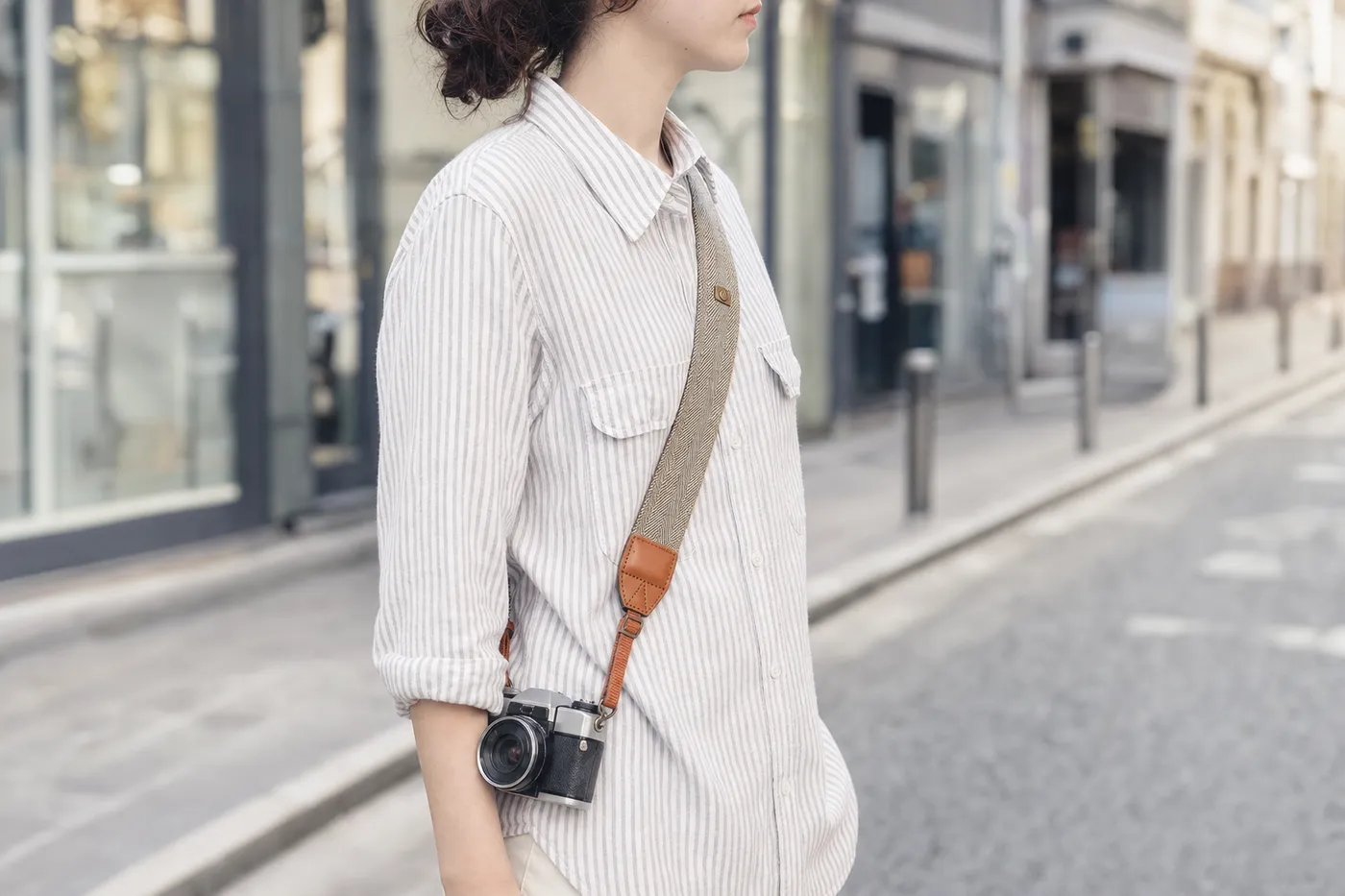
A city day and a trail day ask different things of a strap. In a city the ground is flat and nothing else lives on your shoulders. On a trail the ground tilts both ways, a pack has claimed both shoulders and your waist, and the light you brought the camera for lasts four minutes.
This guide covers that day: what a slope does to a hanging camera, how a strap and a pack divide one body, and what sweat and weather ask of our two materials. The general technique is already in how to use a camera strap, and this page assumes it.
Read this first. Camstrand builds one thing in seventeen models: a two point strap that attaches at both lugs and is worn at the neck or across the body. Everything below is about wearing it with a pack on, on ground that is not flat.
The quick verdict
What it leaves open is which shoulder, and whether the strap runs over or under the pack. Most people carrying a camera outdoors are on a marked path for an afternoon.
recreation visits to the National Park System in 2025, across 1.39 billion visitor hours
— U.S. National Park Service, Office of Communications news release, 2026
When the ground stops being flat
Descent is what people notice first. You land on ground lower than the ground you left, and your torso drops with it. The camera does not drop at the same instant: the strap goes slack, then takes the weight again at the bottom of the step. A few hundred of those is why photographers end up holding the body with one hand all the way down.
Side slope is the quieter one. On a path cut across a hillside your body is tilted even though you walk straight, and everything hanging on you slides downhill. A camera at the neck stops being centred the moment the ground goes sideways. Across the body on the uphill shoulder, it is pulled into your ribs instead.
One plain point about neck carry belongs here, without drama. A camera on a neck strap hangs from a single point behind your neck and swings in front of your sternum, so on broken ground it has more room to move and more things to meet. That is not an argument against neck carry: it is why the same strap gets moved across the body on a trail, which is a length adjustment rather than a different strap. The shoulder and crossbody page covers how the load moves when you do it.
Length is the other lever, and the one people leave alone for years. A city setting puts the camera at the hip so your arm shields it. A trail setting wants it shorter, high enough to rest against your lower ribs where the swing is smallest. Both ranges adjust: the cotton band slides on its webbing tails, the braided cord moves through its ring before you lock it off. Setting the drop is covered on the camera neck strap page.
A pack and a strap share the same two shoulders
How a pack divides its own load has been measured, and the split is what makes this more than a preference.
of a backpack's vertical force borne by the lower back versus the upper back and shoulders, with an external frame pack and hip belt
Even with the belt doing its job, most of the pack still rides the upper back and shoulders — the same hardware your camera strap wants. That is not a reason to carry less camera. It is why routing has an answer.
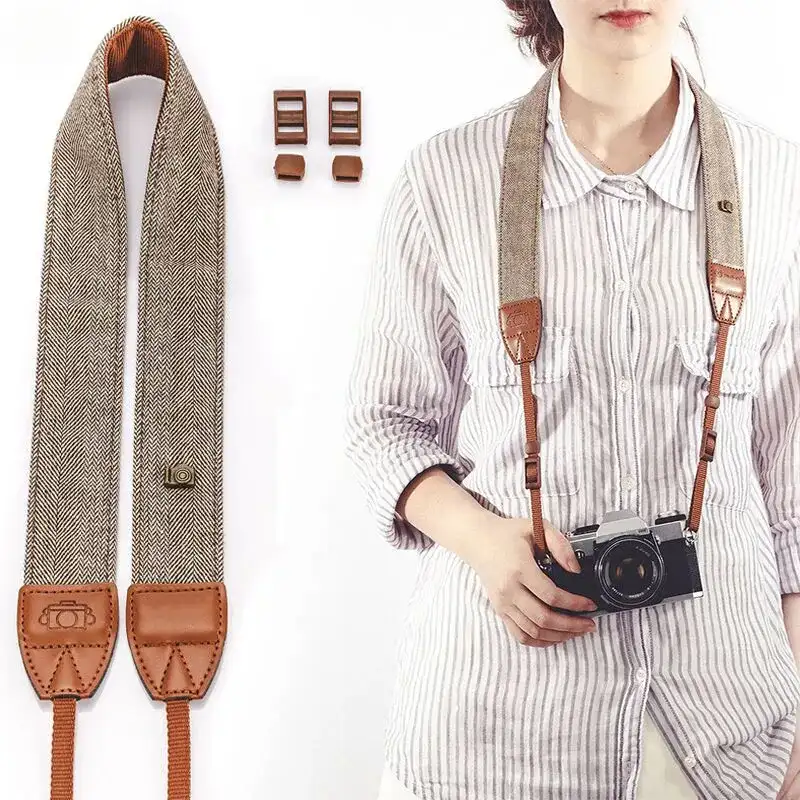
Three interfaces, three decisions. First, the shoulder straps. A camera strap run under a pack strap is held flat and cannot walk off you, and it is trapped there until the pack comes off. Run over the top it stays independent and free to slide, which is where a wide woven band earns its place: more face against pack fabric means it creeps less than a round cord.
Second, the sternum strap. That clip sits at almost exactly the height a cross body strap wants to cross, and when the two share a line the camera strap is pinned at an angle you did not choose. Moving the clip a notch is a one second fix.
Third, the hip belt, which decides how the day feels. A camera at hip height lands on a working belt, bumps it on every step and sits where your hands go to release the buckle. Carrying higher on the ribs takes it out of that zone — the same adjustment the descent asked for.
Reaching the camera when the light changes
Mountain light runs on its own schedule. A cloud edge moves, a valley fills, and a scene that was flat for an hour turns photographic for four minutes. If reaching the camera costs a stop, a pack off and a rummage, you photograph what is left.
With the strap set short the sequence is: hand finds the body against your ribs, lift, frame. No hunting, no looking down. That is why it rides high — at the hip it needs a bigger lift and a belt to clear.
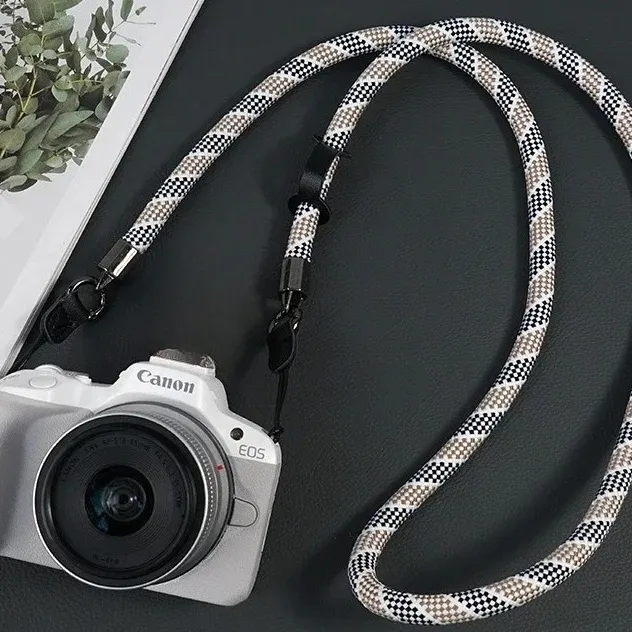
The second kind of access matters more outdoors than in a city: getting the camera off. Setting up on a tripod, or freeing both hands, goes faster when the strap leaves the camera without unthreading anything. That is the ring system on the braided rope range, taken apart in how a quick release camera strap works. The cords stay on the body, so it is back on in seconds.
Sweat, rain and what the two ranges do with them
Cotton against skin is why people who walk all day tend to choose it. It does not go slick when you sweat, it does not squeak against a collar, and it softens with use instead of staying board stiff. The trade is that a woven band holds more of the day on it than a cord does, which is a laundry question rather than a durability one.
The braided cord takes the opposite position. A round nylon cord has far less surface touching you, so there is less of it warming up under a pack strap on a climb, and it vanishes under a shell when the weather turns. It also threads the smallest lugs, an argument covered in the compatibility guide.
Rain is mostly about the leather. On the cotton and leather range the tabs and ends are leather, and leather that gets soaked wants to dry slowly, away from a heat source. The rope range meets water with nylon and metal instead, which is part of why fifteen of our seventeen models are cords.
There are two load figures on this site and no others: 6.6 lb (3 kg) on a single attachment lace and 22 lb (10 kg) with both leather tabs closed, both printed on the published sheet for the cotton range rather than measured on a bench of ours. They describe that sheet, not a rating for wet ground, and no equivalent figure is published for the rope. Our how we test page sets out the method.
What the weight costs over a full day on foot
The shoulder is where people who carry cameras for a living report trouble, ahead of any other part of the body.
of camera operators surveyed reported shoulder symptoms, the highest rate of any body part measured
— Annals of Occupational and Environmental Medicine, study of 166 camera operators, 2015
Those are working operators with far heavier rigs, so do not read your afternoon into their year. Read the direction: load concentrates where it is narrowest, and the response is to spread it and to move it.
Spreading it is the wide band's job. The same camera across a wide woven face presses into more skin than on a round cord, so the pressure at any one point is lower — the reason a pack has wide shoulder straps. Over an eight hour day that compounds, and it is what the cotton and leather range is for.
Moving it takes a second. Swap the camera to the other shoulder at every break, the way you would shift a bag. A trail offers the better moment: with the pack off, your shoulders are unloaded and you can feel where the camera really sits.
The trail table
| The day in front of you | Neck carry | Cross body, worn short |
|---|---|---|
| Flat marked path, no pack | Comfortable and fast | Also fine, less centred |
| Sustained descent | Longest swing, hand on the body | Camera pinned to the ribs |
| Path cut across a slope | Hangs to the downhill side | Uphill shoulder holds it in |
| Loaded pack with a hip belt | Competes with the sternum strap | Rides above the belt line |
| Full day, six hours plus | Load split across both shoulders | One shoulder, so switch at breaks |
| Rain and a shell over everything | Camera under the layer | Cord disappears, band stays put |
Two settings of one object: all seventeen models do both columns, and the difference is where you lock the length. The wider comparison of carry systems is in neck versus wrist versus harness.
Short answers
Should the camera strap go over or under my pack's shoulder strap?
Can I use trekking poles with a camera on a strap?
Do I need a different strap for hiking than for everyday use?
If you know which of the two you want, the seventeen models are on the home page. If not, how to pick a strap works through the four criteria, and how to attach it covers its first four minutes.